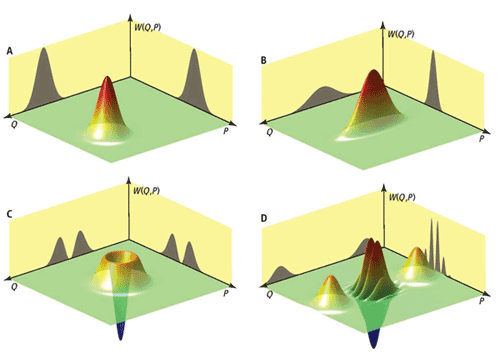
Credit: P. Grangier, "Make It Quantum and Continuous", Science (Perspective) 332, 313 (2011)
Problem Session: TBA
Quantum optics is a broad and varied subject that
deals with the study, control, and manipulation of quantum
coherence associated with electromagnetic fields. This includes
nonclassical optical media, the basic interaction of photons and
atoms, and the nonclassical nature of the electromagnetic field
itself. Quantum optics is the natural arena for
experimental tests of the foundations of quantum mechanics and
measurement, especially in the context of open, nonequilibrium
quantum systems. Most recently, developments in theory and
experiment have led to the possibility of applying the coherent
control of quantum optical systems to perform completely new
information-processing paradigms such as quantum communication
and quantum computation.
Quantum Optics II (Physics 581)
- Quantum optical particles and waves (discrete and
continuous variables)
- Foundations of entanglement and quantum maps
- Open quantum systems and decoherence
- Quantum trajectories and continuous measurement
- Fundamental paradigms in quantum optics (cavity QED, ion and
neutral atom traps, entangled light)
- Applications in quantum information science (quantum
communication, computation, metrology)
"Recommended" Texts (none required):
* Quantum Optics - Scully and Zubairy,
* Quantum
Optics, by R. Y. Chiao and J. C. Garrision
*
Introduction to Quantum Optics: From the Semi-classical Approach
to Quantized Light - Gryberg, Aspect, Fabre
* Quantum Optics, by M. Fox
We will not be following any of these texts directly . They all have strengths in different areas and are good to have on your bookshelf.
Grading:
* Problem Sets (5-6 assignments) 75%
* Final Project 25%
* Problem sets will be available on the web, about every other week. Generally assignments will be due Thursdays in DropBox.
Phys. 581: Quantum Optics II
I.
Nonclassical Light
A. Nonlinear optics and nonclassical light.
B. Squeezed states.
C. Homodyne detection.
D. Phase space
methods -- Quasiprobability distributions, P-Glauber, Q-Husimi,
W-Wigner functions.
E. Correlated twin photons.
II.
Foundations
A. Bipartite entanglement.
B. EPR and Bell’s Inequalities, finite and infinite
dimensional systems.
C. Completely-positive map, Kraus operators, and POVMs.
III. Open quantum systems
A. System-reservoir interactions.
B. Born-Markoff approximation and the Lindblad Master
Equation.
C. Phase-space representation: Fokker-Planck equation.
D. Heisenberg-Langevin equation.
IV. Continuous measurement
A. Quantum trajectories - different unravelings of the Master
Equation.
B. Quantum Monte-Carlo wave functions.
C. The stochastic Schroedinger equation.
V. Applications in quantum information processing
A. Quantum communication
B. Quantum computation
C. Quantum metrology
|
Jan. 20 |
Review:
Coherence, Particles and Fields
|
|||
|
Jan. 22 |
Discrete and Continuous
variables
|
|||
|
Jan. 27 |
Squeezed states,
general properties
|
Lecture
#2 Podcast #3 |
||
|
Jan. 29
|
Quadratures, shot noise, and homodyne detection |
|||
|
Feb.3 |
Introduction to nonlinear optics and
the generation of nonclassical light |
Lecture
#3 Podcast #5 |
||
|
Feb. 5 |
Three Wave Mixing Production of Squeezed States | |||
|
|
Introduction
to Phase Space Representations |
Lecture #4 Podcast #7 |
||
|
|
Wigner Function |
Podcast #8 |
||
|
Feb. 17 |
Operator Ordering and Quasiprobability
Distributions Wigner (W), Husumi (Q), and Glauber
(P)
|
Podcast #9 | ||
|
Feb. 19 |
Continuation |
Podcast #10 |
||
|
Feb. 24 |
Wigner function Dynamics |
Podcast #11 |
||
| Feb. 26 | No lecture |
|||
| Mar. 3 | Introduction to Entanglement |
Lecture #5 Podcast #12 |
||
|
|
Schmidt Decomposition EPR |
Lecture #6 Podcast #13 |
||
Mar. 10
|
Bell's Inequalities |
|||
Mar 12 |
Entanglement in quantum optics - particles and waves Spontaneous Parametric Conversion Time-Energy Entanglement |
Podcast #15 |
||
Mar 13 |
Polarization Entanglement |
|||
|
Mar. 16-20 |
Spring Break |
|||
| Mar. 24 |
Intro to open quantum systems:
Quantum operations, CP maps, Kraus Representation |
Lecture #7 Podcast #17 |
||
| Mar. 26 |
Continuation
|
Podcast #18 |
||
|
Mar. 31 |
Derivation of the Lindblad
Master Equation Born-Markov approximation
|
Lecture #8 Podcast #19 |
||
|
Apr. 2
|
Continuation |
Podcast #20 | ||
|
Apr. 7 |
Examples of Master Equation Evolution: Damped two-level atom |
Lecture
#9 Podcast #21 |
||
|
Apr. 9 |
Damped Simple Harmonic Oscillator |
Lecture
#10 Podcast #22 |
||
|
Apr. 14 |
Quantum Trajectories I Introduction to Quantum Trajectories |
Lecture
#11 Moelmer 1 Podcast #23 |
|
|
|
Apr. 16 |
Quantum Trajectories II Quantum Monte-Carlo Wave Function Algorithm |
Lecture #12 Moelmer 2 Podcast #24 |
||
|
Apr. 21
|
Quantum Trajectories III Coherent Population Trapping |
Lecture #13 Moelmer 3 Podcast #25 |
||
|
Apr. 23
|
Different Unravelings of the Master Equation |
Podcast
#26 |
||
|
Apr. 28
|
Quantum Trajectories III The Stochastic Schrodinger Equation. Continuous measurement |
|||
|
Apr. 30 |
No Lecture
-- to be made up |
|||
May 5 |
Heisenberg-Langevin Equations |
|||
May 7
|
Master Equation in Phase Space Fokker-Planck Equation and Decoherence |
|||
| May 8 | The Quantum-to-Classical Transition | |||
| End of class! |
|
Problem Set #1 |
|
Problem Set #2 |
|
Problem Set #3 |
|
Problem Set #4
|
|
Problem Set #5
|
|
Problem Set #6 |
Problem Set #7
(Extra Credit)
|
FINAL Project |
F